Friday, July 19, 2013

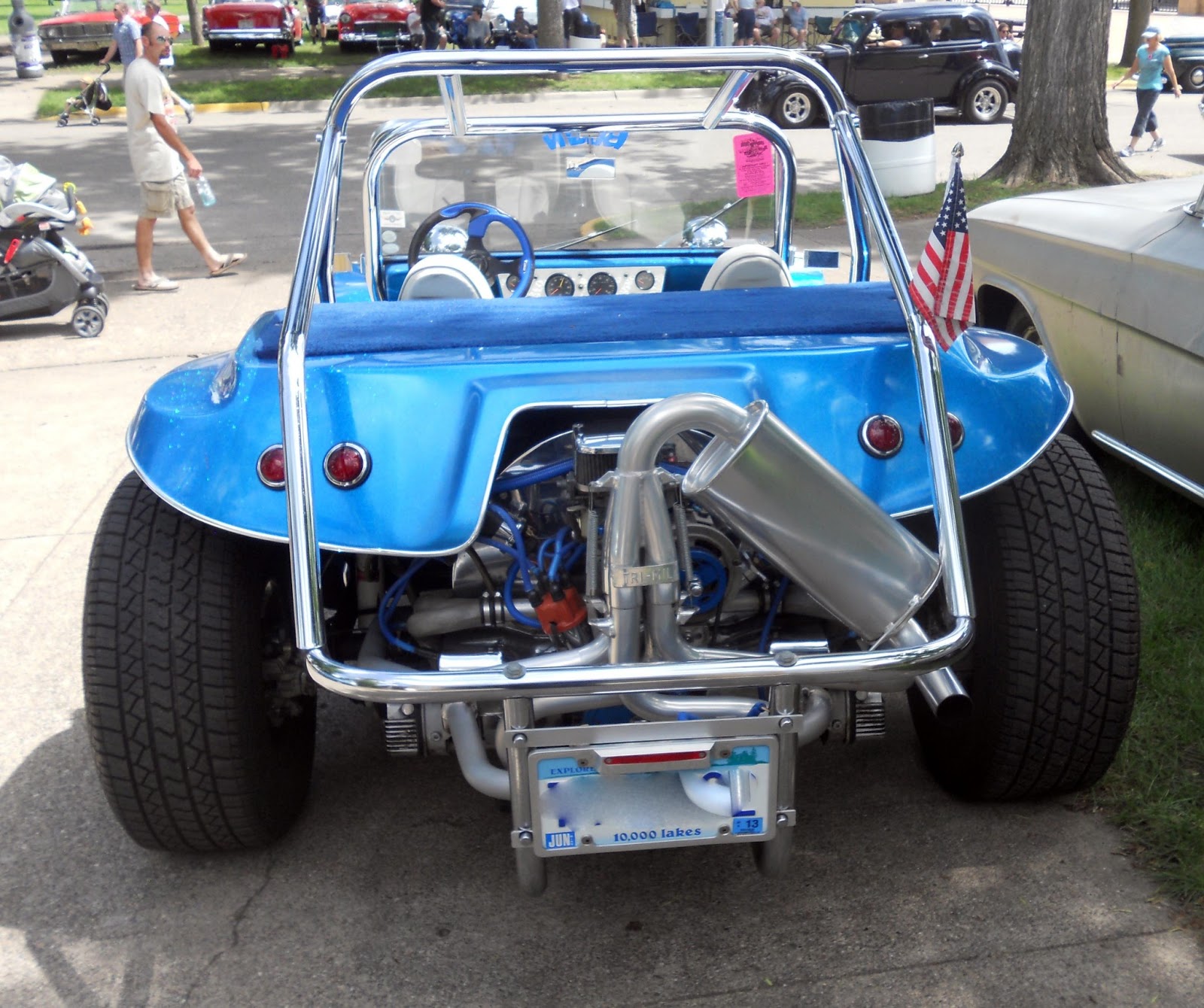
Blueberry Dune Buggy!

To wrap up our fruit inspired car week, we’re going to top things off with a little blueberry.  This Dune buggy isn’t an actual Meyer’s Manx buggy as near as I can tell because it lacks any type of badge saying it is, and the window show tag didn‘t declare it a Meyers Manx, which it certainly would have if it was the real deal.  This is based on a 1963 VW, and it sure is inspired by the original Manx.


The Meyers Manx was a custom built machine made back in the mid 1960’s by a guy named Bruce Meyers, who lived and worked in California as an engineer and boat builder.  He wasn’t a professional race car driver, but he sure managed to lay waste to a bunch of pros while showing off his prototype dune buggy in what would come to be known as the Baja 1,000.


Based on a chopped down VW Beetle fitted with a fiberglass body, the Manx was light, easy to handle, and capable of trouncing sand dunes even without 4x4.  In spite of the fact that Bruce patented his creation, his design was emulated, and sometimes just plain ripped-off by other companies.   Engines and power depended on what VW was used as the source car (all flat 4’s though).  The vast majority of these buggies were street legal, though the very nearly open wheel wells meant they could be fitted with super nubby tires to claw and crawl up dunes.  Buggies like these straddled the line  between off road jeeps and dirt bikes (quads weren’t really so big yet back then), and the design became iconic in off road racing and pop culture.  Even Barbie had a dune buggy that looked like a Manx (in pink, of course).


Bruce Meyers had left his company by the time it met with financial problems involving the IRS in the early 1970’s, but he founded (more like refounded, though) the Meyers Manx, Inc. company in 2000 to do a small run of buggies and sell kits.  The buggy pictured here was one of two Dune Buggies I saw at this particular car show, and even that number was surprising to me.  It’s not like Minnesota is known for having vast deserts to race across.  I’m sure people manage to find fun stuff to do with these things anyway, though.


I tried to find some numbers for what one of these would cost nowadays, and it’s all over the place.  Mostly, it seems that it really depends on what car has been used for the buggy donor.  I found a listing for a genuine Meyers Manx for just under $5,000.  Of course, you could just go to the Meyers Manx website and buy a brand new “Kick-Out” Manx Traditional kit for $4,700 and build your own.  They’ve also got some cute looking newer models available in kit form including one called the Manxter 2+2 for $5,895, and a Manxter DualSport kit for $8,545.   But what about stuff that’s already built and ready to go.  Well, I found an online listing for a dune buggy built on a Subaru platform with twin turbos for $19,500, and a Manx knock-off based on a ‘68 VW for $18,000.  The prices drop to nearly half that for other versions that seem like they’re more street oriented and less Baja ready, and half of that number even for another street-tire equipped Manx knock-off ($4,000 if you’re willing to go to Arizona to get it).  If you want to build your own and don‘t care if it‘s the official Manx or not, there’s a guy in Connecticut who wants to sell you a kit for $1,499 (OBO).  If you wanna get all back-woods about it, you could head to Arkansas and get yourself a real post-zombie-apocalypse style rig that looks like it was cooked up in a meth lab…no paint, no fiberglass body, a roll cage that looks like it was welded together out of old bicycle frames, a bus transmission, and rims that look like they were pulled off a car that was sitting in the junk yard for a decade or two.  It’s totally lick’em-stick’em, but you can tweak out with it for only $750.    Seems like there’s something for just about every budget in the dune buggy world!  

Thursday, July 18, 2013

Lean, Mean, Green Machines ...and the Limey Little Winner of Today's Post Feature.

I have a penchant for green automobiles.  I even drive a car painted “Legend Lime” green.  So, it probably won’t surprise you to learn that I had some difficulty deciding which green car to feature today -I’m fond of so many of them.  I could have featured my own Mustang, the Electric Green one I had before this one, my British Racing Green MG, or this “Gotta Have It Green” Mustang from the Ford Racing display (be still my heart!).


…Or I could have gone with something more iconic a la 1950’s like this ‘57 Chevy.


How about this Plymouth Roadrunner?


Nah, we need something with a bit more tang to it… Could it be this Edsel?


Uh, no, that’s too sour.  Just look at the puckered up grille on that Edsel.  Not today.

Something tart but sweet with just the right amount of tang is what today’s fruit inspired car needs to be, and I've found just the thing.  How about an itty bitty Key Lime?


Perfect!  It’s a BMW Isetta 300 that I found perched on a lift at a repair shop situated in a small town in Iowa that specializes in small engine repair and Saturns.  I blurred the plate, but those of you who are from good ol’ I-oh-way will probably recognize those solid blue plates from a decade or two ago before they were replaced with the slightly nicer looking ones that supposedly show a view of the Des Moines skyline with an extra building or two thrown in to make it seem a bit more metropolitan.  Eh, what the heck, I’ll take phantom buildings over a license plate that features corn cobs any day.

BMW’s Isettas are perhaps the best known ones, but BMW (Bayerische Motoren Werke -AKA Bavarian Motor Works) didn’t actually come up with the car.  The Isetta was designed by an Italian design firm called Iso SpA that also built refrigerators and scooters.  Iso took their design and licensed it to manufacturers throughout the world.  BMW bought one of those licenses as well as the tooling to build it in 1954.  The original Isetta featured a single cylinder 236 cubic centimeter (14.4 cu in.) motorcycle engine that could make the car go from zero to sixty in roughly the time it would take to have just walked whatever distance ended up being covered.  Well, that’s not totally true.. 0-30 took over 30 seconds, and the Isetta did 0-60 in NEVER.  That’s right.  The top speed of an original Isetta was 47 MPH, so unless you’re gonna’ get out and push really hard, that 60 MPH just isn’t going to happen.


The Isetta is considered a “microcar” -shocking, isn’t it?  No?  Well of course not!  It’s probably the most recognizable micro, but it has company both from back in its day and in modern times.  If you saw that Addams Family movie about a decade or two ago, then you may have noticed Cousin Itt driving a Messerschmitt KR175.  There are also the old Fiat 500s (the new ones come dang close and may actually fit the criteria too), and the Goggomobil, as well as the modern Smart Fortwo, and the smallest of all (as production microcars go) the Peel P50.  While I wouldn’t consider it to be in good company, per se, at least we can firmly state that the Isetta definitely has company.

I like to look at these itsy bitsy autos, but they’re not the type of thing I have any desire to own.  If I had one, I’d want to drive it, and when you drive something small, there’s a good chance that something big (which, relatively speaking here, could be a Mini, a Goldwing motorcycle, or a hamster ball being piloted by an obese rodent) is going to come along and cream ya’.  There really isn’t much that a driver or passenger of a microcar can do in the event of a major collision other than die or get extremely mangled.  On the bright side, parking should be easy to find.  You could squeeze in just about anywhere with a microcar.  

BMW redid a lot of things on the Isetta.  So much so that you can’t swap any parts from an Iso Isetta back and forth with a BMW Isetta.  They just won’t fit.  Among the many things BMW replaced was the engine.  The result was 3 variations of the Isetta available to consumers:  The 250, the 300, and the 600 (all rounded-up versions of the cubic centimeter displacement of the engines, which were actually 247cc, 298cc, and 582cc).  The one we’re looking at is an Isetta 300.  Its scurvy little single cylinder engine packs a measly 13 HP and 13.6 lb ft of torque for a top speed of 53 MPH.  I’m not absolutely certain what year this one is, but they were only made until 1962.  This one still wears its original paint, a color called “Reseda Green”.
 

Brand new back in the day, an Isetta would set you back roughly $1,100.  For that sum, you got a car that measured 7’5” long, 4’5” wide, 4’4” tall, and weighed in at right around 800 lbs. sans passengers.  It had a 3.4 gallon fuel tank and would get roughly 50 MPG.  The only thing separating occupants from whatever might hit them head on, or whatever they might run into is the door (AKA the entire front plane of the car), which hinges open for entry/exit/extrication.


Clearly, today’s little limey squirt is a work in progress.  Years of wear, tear, and neglect have turned it into a restoration project.  At the moment, it doesn’t have much in the way of an interior going for it.  What should be there, though, is a little bench seat  that could fit two adults (maybe) and possibly a small child (safety and booster seats be damned!) if they all packed themselves together like sardines.  I rip on it a bit, but Isettas are fun.  That’s the real reason to have or keep one around: the quirkiness of the whole thing.  They’re just such goofy little cars, you can’t help but admire them.        

Wednesday, July 17, 2013

What rhymes with orange? ...Okay, nothing -but here's a '48 Chevy Aero to look at!

We ended up with a banana instead of a lemon yesterday, so we should probably get some citrus today.  Here’s an orange 1948 Chevy Aero.  This car is the fastback 2 door version of the Fleetline,  What’s odd about these is that the two door was referred to as the “Aerosedan” -and that sedan part would imply a 4 door vehicle, but the 4 door actual sedan was called the “Fleetline Sportmaster“.  You’d think it would be just the opposite.


Something else of note about these cars is that on the first renditions of them, you had to remove a bumper guard before you could get the trunk to open.  By the time 1948 rolled around, Chevy used a bit more sense in their design.

These were rear wheel drive cars with 3 speed transmissions, and it was rare that you’d find one with overdrive, so you know, not a whole lot fun on the interstate.  And that’s fine because back in ‘48, the interstate system was still in its early years of development.  In fact, it wasn’t until 1992 that the original Interstate Highway system was officially considered complete.  And anyway, even without the lack of gears in the transmission, the ‘48 Chevy didn’t have much power to offer by today’s standards.  It had a 216 cubic inch inline 6 cylinder engine with 90 HP and 174 lb ft of torque for a top speed of 71 MPH.  


The look of the car is probably its best feature if we’re talking about one that’s completely stock.  It’s got that puffed up, slightly hump-backed, chrome-accented appearance that is still just barely wafting on the breeze of an Art Deco influence on automotive design that was more prevalent in vehicles of the mid and late 30’s like the Lancia Astura, the Cord, or the Auburn Boattail speedster.  But in ‘48, there were still some players in the Art Deco car market blinging up the streets with absolutely artful sheet metal work, like the ’48 Talbot-Lago 26 Grand Sport.  This Chevy was built less for looks and more for function, so its style quotient sit’s a bit lower on the scale than something more rare and exotic like a Talbot-Lago.  In that way, it’s kind of like comparing apples to oranges… or an orange to some rather rare and particularly shiny apples.


Today’s citrus-infused oldie probably doesn’t even have its original engine or transmission.  In fact, I’d be willing to bet that most of the functional components of this car have been upgraded over the years.  Unlike with rare and special edition vehicles, where swapping out original parts for better, more modern bits harms the value, in this case, it would enhance the worth of the vehicle.  These old Chevys weren’t all that special, but you can bet that this one is special to the person who owns it.

Tuesday, July 16, 2013

Lemon or Top Banana? The 1972 Dodge Challenger.


In keeping with our fruit theme this week, one could say that today’s car is lemon yellow, but lemon isn’t a term that denotes good things about an automobile.  In fact, the paint color on today’s car does have a fruity name of its own, and it doesn’t involve any type of citrus.  Say hello to the “Top Banana” yellow 1972 Dodge Challenger!


The real vintage Challengers that the modern day ones you can buy at your Dodge dealer are based on came from the era between 1970-1974.  More specifically, the retro style of the new Challenger is based on a 1970 model, which you could see from the tail lights spanning the width of the car’s rear plane and the shape of the grille if I had photos of the two cars side by side for you to look at -which I don‘t, so too bad. 


As vintage Challengers go, the ones that are most desirable are your 70 and 71 models, because they were built prior to government environmental meddling and could be had with big block engines like the 383 cu in Magnum V8 (335 HP), a 440 cu in V8 with a 6 pack of carbs (3 sets of 2 barrels, making 390 HP), or the big, bad 426 Hemi (packing 425 HP).  By ’72, government regulations put the kibosh on all that rip-snortin’ fun and the Challenger was relegated to using only small block V8’s and puny 6 cylinders to whip around with.   

In 1972, this was your choice for engines: a 225 cu. in. 6 cylinder with 110 HP (Bleh!), a 318 cu. in. V8 with a 2 barrel carburetor and 150 HP (slightly less Bleh!) and a 340 cu. in. V8 with a 4 barrel carburetor and 240 HP (it’ll have to do).  Top Banana here just happens to feature the big one, so at least it is at the top of it’s rather insignificant heap. 


The place in Mankato that is offering this ’72 model for sale ($27,900, BTW) has erroneously labeled it as an R/T -something that’s not possible, because in 1972, Dodge dropped the R/T packaging in favor of what’s called a “Rallye” package.  It’s particularly easy to identify because the Rallye package featured dummy fender scoops with strobe effect stripes streaking across the side plane of the car.  Hmmmm.. dummy scoops, check… strobe stripes… check.   Yeah, this banana is not an R/T, it’s a Rallye.


To give you an idea of the difference it makes to have a 70-71 big block vs. this 72 that’s loaded with all it could have, you could go to Mankato, MN and take a look at the lot this one is sitting on.  Right next to it is a brown 1970 R/T Challenger listed with a sale price of $45,900.  But even that’s not top dollar car as vintage Challengers go.  Lets once again pull out our copy of Hemmings Motor News and have a look-see at what’s for sale.  There’s a 1970 Challenger R/T convertible with the 440 six pack that supposedly was owned by Bob Hope available for the bargain price of $144,900.  There’s a factory super stock drag car 1970 Challenger R/T with the 440 for $99,000... They don‘t even have any Hemis listed, but those would cost a bunch more than the 440 if they did.


On the flip side, you can get a 1970 6 cylinder Challenger for $14,950.  For that price, I’m going to bet it may not be a numbers matching vehicle anyway, so one could pick it up and invest another pile of money transplanting a new Hemi crate engine.  If you really modernized and went with one of the new non-carbureted ones, you could get a solid 425 HP 6.1L SRT-8 Hemi for about $7,000 -of course, you’d have to upgrade a lot more than just the engine to get that set up to work.  Probably around the time you reached the $30,000 mark between the cost of the car and the cost of engine, transmission and other upgrades, you’d have all the components you need to make a monster of a Challenger, and though it would definitely be a resto-mod rather than a pristine original, you’d be able to keep up with and possibly smoke the originals for a lot less money.  But back to the Top Banana we’re here to discuss today. When all is said and done, this ’72 Challenger is still a decent looking car that did the best it could with the hand it was dealt.      

Monday, July 15, 2013

Cherry Mash -the 1963 Ford Fairlane

Just yesterday, I harvested my first bowl of cherries for the season from the two little cherry trees I planted in front of my house a few years ago.  In previous years, my crop has consisted of just a handful of these tart little gems, but this year, both trees are absolutely brimming with juicy little red cherries.  Tart cherries are loaded with anthocyanins (antioxidants) which reduce the chances of developing heart disease and cancer and also work as an anti-inflammatory for people with arthritis.  They are packed with vitamin A (beta carotene), with a good dose of vitamins C, and E as well, on top of which they are a good source of Melatonin.   I brought some to work with me yesterday to share with coworkers, and was promised by one that she would bring her grandfather’s recipe for Cherry Mash next time she saw me.  I don’t really bake pies or anything, and eating these cherries is nice, but there’s no way I can eat all of them, so turning my bumper crop into booze sounds like a fantastic idea to me -though I will probably lose some of those health benefits of the cherries.  My coworker says her grandad’s recipe takes a few months to ferment, which means that I’ll likely have some potent cherry mash by Christmas time. 


I should give some props to my little cherry trees for being as resilient as they are.  It’s a good thing they seem to thrive on neglect because I’ve done absolutely nothing to help them along this season.  On top of that, one of the little trees survived a mauling by a particularly nasty lady who was upset that I called the cops on her because she was assaulting her no-good, cheating boyfriend at the bus stop in front of my house one night a couple years back.  After the cops left (nobody wanted to press charges), the lady involved, a large beast of a woman, came charging up my steps and to my window, yelling “It’s on, bitch!” before going over to my little cherry tree sapling and snapping it in half.  As if I was in the wrong calling the police to a situation where she was domestically abusing her boyfriend, who was significantly smaller than she.  She was on top of him, slapping and hitting him and essentially squashing him into my retaining wall -oh, but I’m the bad guy for calling for help rather than turning a blind eye to the situation.  Well enough ranting… It’s just what happens when you’ve got a bus stop situated in front of the house you live in.  I’m not a fan of public transport, mostly due to the behavior I see exhibited by the folks who make use of it outside in front of my home.  You probably won’t see me doing a profile of a Metro Transit bus anytime soon -or at least not a favorable write up of one. 

But I digress.. Back to the cherries.  Now, you may be wondering why I’m talking about produce.  After all, this is a blog about cars.   Rest assured, I have a plan, and this cherry business was the inspiration for it.  This week, we’re going to be looking at cars that I choose based on their fruity paint jobs.  So, let’s meet today’s cherry red automobile.


This is a 1963 Ford Fairlane 500 2 door hard top.  Note that I wrote hardtop rather than just coupe because there’s no B pillar.  This car is kind of special to me because back when I was in high school, my siblings and I used to drive one of these.  Ours wasn’t cherry red, but rather more of a rose burgundy color, but it was the 2 door hard top with those cool fins and the white streak along the side.  It was kind of a neat car, but it sucked up a ton of gas and had the unfortunate habit of filling the passenger compartment with smoke and fumes while we drove along.  It wasn’t too long before it was taken out of rotation and replaced with a really shitty Chrysler Cordoba (it was brown and looked like a turd on wheels -I hated that car), which was then taken out of rotation in favor of a boxy little Ford Bronco.

The Fairlane was on the sales floor of Ford dealerships from 1955-1970.  It’s named after something that was near and dear to Henry Ford’s heart: his home, Fair Lane in Michigan.  The ‘63 Fairlane was the fourth iteration of the model name and was considered a mid-sized car.  Its little sibling was the Ford Falcon, which was briefly mentioned in the recent post regarding mallard ducks, and its big brother was the Ford Galaxie. 


The Fairlane 500 2 door was priced between $2,300-$2,600 back in 1963 and came standard with a 2.8L V6 that was good for 101 HP, but the one from my youth had a V8.  These days, I’m not so sure if it was the 289cu in V8 that was good for about 195 HP or if it was the smaller 221 cu in V8 that produced 145 HP.  Either way, by the time my siblings and I got our hands on that car, the engine was on its last legs.  My parents still have the old Fairlane, and it’s sitting around as an incomplete project car at this point.  If I was anywhere nearby, I could stop in and jot down the VIN from the car, which would let me know what engine spec it originally featured, but alas, I’m not even in the same state.  

Some years ago, we yanked the engine out of the old high school whip after a complete mechanical failure only to discover some serious rust issues in the frame and suspension.  The plan was to rebuild the car to a new and improved state so my brother could be reunited with his clunker.  This plan would include cutting out the rust and fabricating new components to weld in place while at the same time replacing the front suspension with one pulled out of an AMC Pacer (it’s an improvement, trust me).  After that, we’d replace the original engine and transmission with a 302 V8 paired with a C4 transmission -both of which are prepped and resting on some stands in the garage at my parent’s house.  Alas, other projects took precedence (I got distracted by a very needy MG), and things came up, so this work has yet to be completed.  It really is a daunting task though, because rust issues are a major problem to deal with.  Not just that, but after all this work, there would still be body work to do on the car thanks to yet more rust issues in the door sills and around the lip of the wheel wells.  It’s the type of thing that had better be a labor of love because the investment in the vehicle isn’t going to provide a good return money wise. 

You know what would be worth restoring though?  Lets hop up one year from 1963 to see.  The 1964 Fairlane that came after this one lost its fins, which I think is a shame, because I love fins on cars.  What it gained though, was a “Thunderbolt” drag racing package option that plopped a 7.0L V8 under the hood with two 4 barrel carburetors, a ram air set up that flowed through the place where the inner two headlights had been in the grille.  The Thunderbolt also featured a lightweight, fiberglass hood, trunk mounted battery, stripped down interior, and nearly 660 HP.  Very few of these were made, and if you ever run across a genuine one, even if it’s a complete basket-case sitting in a junk yard (unlikely, but if you do find one there, buy it) you’ve stumbled on to something special.

So, today’s Fairlane is in cherry condition, whereas the Fairlane from my high school days is more of a cherry bomb at this point.  Until it’s restored, I’ll just have to settle for a bowl of cherries from my little trees.